Friday, November 26, 2010

Falls Cameo

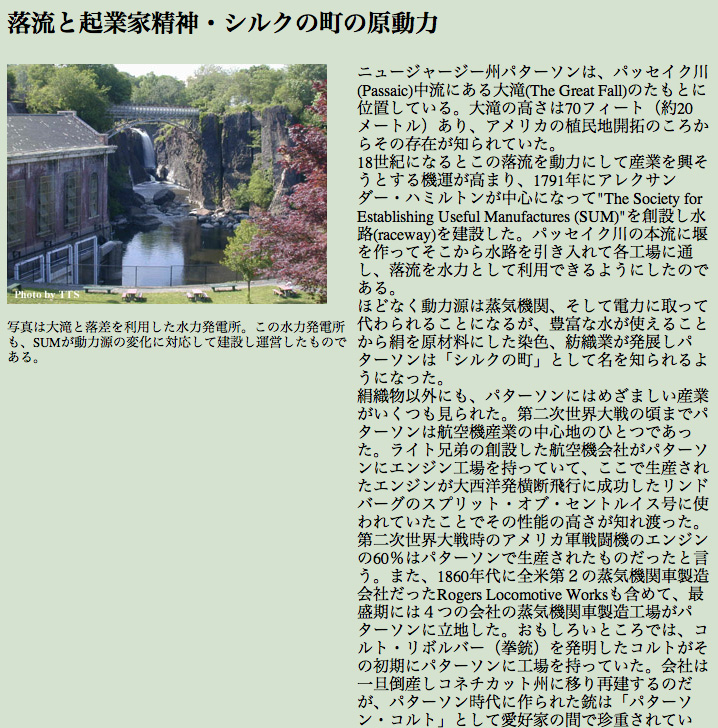
Damn. Even though D. W. Griffith filmed his famous ice floe climax of Way Down East in Connecticut, I'm almost certain that this cutaway is the Passaic Falls . . . which makes perfect sense, since for a long time Griffith worked in the industry when it was still in Fort Lee, New Jersey, just down the road from Paterson.

Labels: , , , ,

Tuesday, May 18, 2010

--the being taut, balanced between eternities

The newspaper accounts of tightrope walkers DeLave, Harry Leslie and Geo. Dobbs, mentioned in Book III that I can find are not as interesting as this description of a promised future event, and the aftermath of one of the DeLave walks across the falls:
"The performance was now concluded. DE LAVE gave notice of a repetition of the feat on Monday next, when he would walk with peach baskets tied to his feet, stand on his head, and perform other 'terrific feats.' A large number of pickpockets were on the ground, and one man, ISRAEL MONSON, a butcher doing business in Main-street, lost his pocket-book containing the avails of his week's business -- about $115."
In the following description of a walk by Harry Leslie (Williams found a much better one, which maybe shows how his archivalism trumps that of instant digital access), we see how his walk, the fall of Sarah Cumming, and Sam Patch's leap, all are memorialized by a "blasted pine"--an evocative image that I don't think Williams uses, perhaps because it might have resonances with the landscapes of Romanticism.


No search brings up Geo. Dobbs, except a software developer's site with a weird article titled "Dr. Dobbs: Funambulism and the Perpetual Tension of Software Development," which uses the tightrope as an extended metaphor for maintaining tension between old and new "platforms": "The innovation that will help us regain our balance as developers is not just in this deeper dive, but in treating the entire software system holistically. It won't be sufficient to just analyze the source, or the assembly process, or the tests that exercise the software. We'll control the tension with technologies that are not just process oriented (like the current ALM suite), but with tools that fundamentally understand and communicate what's happening in a software system at various stages of development. This will enable us to optimize our coding and testing to improve software quality, as well as the productivity of every developer. After that, the crowds will cheer as we reach our platform, ready for the next development challenge to present itself." Yes, but can you do it cooking an omelet, in female attire, while doing the "Washerwoman's Frolic"?

Labels: , , , , , ,

Monday, April 12, 2010

A Time Before Slaughter and Other Updates

I've started to teach Paterson for the first time, and I am structuring a whole course around it, so I was expecting to be posting more, but the little insights proliferate and flow away. I did finally get a new copy, and it's nice to have some clean pages (to dirty again . . . ruing how the mind continues), and then another copy of the older version made it my way, just as I was starting to reflect on transcription inconsistencies (the true mark of "overreading"?) I had Paul Nelson come in to class today to talk about his Patersonesque project about Auburn, WA nee Slaughter in his A Time Before Slaughter; in his long poem, the absence of water flowing seems to be an interesting inverse of the presence of the falls in Paterson. That is, instead of the falls and its water being a source of energy and industry in Paterson, here, because of the way the snow melts off the mountains in these parts, the settlements would have been impossible without getting rid of the water--in the form of damming and rerouting or eradicating the natural waterways. . . . with the attendant displacement of native Americans and natural resources. This connection to Paterson in the Pacific Northwest will be important for this class since I'm asking students to imagine their own Patersons, using a combination of creative research and writing using Google maps as an interface. We'll be doing Frank O' Hara, Alice Notley, Robert Smithson, and other related writers since this class is a reformulation of the "everyday life" class that I've taught before, here and at Brown, but in the past with less of an emphasis on poetry.
In semi-related Williams news, some mention of Williams made it into this new piece of mine just out in Triple Canopy on the rolled r, called "R, Adieu."

Labels: , , , ,

Saturday, January 30, 2010

the ®eal thing

I was teaching Silliman's ® this past week, which has a couple of jokey references to Book II of Paterson: "The ascent beckons, using an alarm clock"; "The dissent bickers as the assent hunkered (memory is a kind of astonishment)." I didn't think that these were the most interesting aspects of the poem. But, as usually happens with the flow of class conversation, and as an attempt to bring students into the poem gradually, I started off with the first four lines . . . again, so flat, distanciating, and jokey that I wasn't sure how interesting they would be for discussion at first:

"Touch me first.
There was a young man from Nantucket.
Poem is the practice (corner of forehead in rear view mirror).
Gonna sit right down and right myself a ladder."

Since I was asking students to "taxonomize" Silliman's sentences, lines 2 and 4 are fairly recognizable as Sillimanic punning sentences; 3 is a Sillimanic "meta" sentence commenting on process (here both a critique of "reflection"--the forehead in the mirror as the problem of mirroring, and the pleasure of confounding it--but also a hint of the theme of memory to come, with the rear-view mirror being a kind of useful instrument of the short-term capture of what's immediately past). 1 is a little bit more harder to pin, because it seems more typical of a kind of injunction to a lover (and thus a little atypical for Silliman), but when that's the reader, there's a kind of alienation effect involved (there's no way I can touch you BEFORE I read you, unless we are ascribing a touchable subjectivity to words themselves, which is probably the case.) Ah, Brechtians in love. In fact, these whole first lines seem like a love poem that is encrypted even as he pushes the reader away with the flatness of his evocations. We know what the "man in Nantucket" rhymes with. The old song about "writing oneself a letter" rather than a "ladder" is about unrequited love powering writing, courtly sentiment translated into a tin-pan-alley corn. And then it dawned on me that this connection between "ladder" and "letter" is what really turns the whole piece into a kind of commentary on Williams' discovery of the triadic line, and the optical effect that he institutes with the "descent beckons" passage. Because, just as the "descent beckons" down the page (like the flow of the falls) while "the ascent beckoned" (forcing our eye back up to make sense of what we just read, memory activating even as time pulls us forward through the poem, as a kind of conceivable levitation), one "sits right down" (again the pull of gravity downward) to write a ladder (which we usually consider a tool of upward movement, to reach high places). The whole structure of ® is ladder-like, with single sentences running down the page rather than coalescing in paragraphs, and, as with Williams' passage with the "descent beckons" the theme is renewal, in the very simple sense that each sentence seems to be written after waking, and may contain within it a recent memory of a dream. Whether one can get to that dream with the ladder/letter of language, whether that is a dream of love or some other salvation, the writing continues downward, away. But could Silliman's circle-r, instead of "registered trademark" be the kind of momentary "reversal of despair" which Williams grasps fleetingly in the lines:

"The descent
xxxxxxxxxxxxmade up of despairs
xxxxxxxxxxxxxxxxxxand without accomplishment
realizes a new awakening :
xxxxxxxxxxxxxxxxxxxxxxxwhich is a reversal
of despair.

xxxxxxxxxFor what we cannot accomplish, what
is denied to love,
xxxxxxxxxwhat we have lost in the anticipation--
xxxxxxxxxxxxxxxxxxxxxxxxxa descent follows,
endless and indestructiblexxxxxxx.


Listen!--"

Labels: , , , ,

Saturday, March 28, 2009

Barack and the River!

Obama's first national park designation is


Maybe this spring it's time for Silliman to reread Paterson instead!

Labels: , , , ,

Friday, March 27, 2009

Hell Must Be Peopled (1859)

Brimstony! . . .

Campbell, Alfred Gibbs
"INVITATION TO THE CLERGY TO PARTICIPATE IN THE INAUGURATION OF THE TAVERN AT PASSAIC FALLS, N. J."

Ho ! preachers of His Gospel who
Salvation came to bring,
Rest from your labors for awhile,
And join our gathering!

Ye servants of the Living God!
Your fealty cast aside,
And with us for a single day
Stand on the Devil's side!

What boots it that we open wide
Another door to woe,
Through which a still increasing tide
Of human souls shall flow?

Hell must be peopled; and our plan
Is quite the surest one;
Our railway's a descending grade,
Our cars the swiftest run.

Not faster do the waters plunge
Adown Passaic's steep,
Not swifter do the lightnings fly
Athwart the vaulted deep,

Than our good train, when once she starts,
With freight of priceless souls,
Speeds to the pit where, deep and dark,
Perdition's Ocean rolls.

Then come with us and view the train;
The depot consecrate;
Where God's voice in the cataract speaks,
Rum's reign inaugurate!

Ho! servants of the Living God!
Your fealty cast aside,
And with us, for a single day,
Stand on the Devil's side!

1859.

Labels: , , , , ,

Sunday, January 18, 2009

Paterson Datum no. 7


Thanks Luke for letting me borrow your projector when mine died.

Labels: , , ,

Wednesday, July 30, 2008

The Swerve of the Thing

I felt as if Ginsberg’s assertion in the last video clip that “‘no ideas but in things’ means that there's no God, basically” was a little glib, so I decided to take yet another dive into Williams’ materialist (but perhaps crypto-theological) apothegm, this time via Slavoj Zizek, who has been, since his appearance on the scene, the philosopher of the “Thing,” and who has recently taken up the project of “thinking the subversive deadlock of monotheism through to the end.” (71) I find a lot of chance points of intersection in Chapter 3 of The Puppet and the Dwarf with various readings of Paterson, especially Zizek’s reevaluation of Freud’s notion of psychic automata and traumatic blockage. What follows may be more my riffing than a close reading, as can be only possible in this constrained space.
Firstly, those “thousand automata” of Paterson “who neither know their sources nor sills of their/ disappointments,” may in the end, be better materialists than Williams is; the language fails them, but they operate fine, and are the body of the demos. They are Paterson. Williams, in contrast, posits himself as alienated demiurge of the things he sees—the things emerge from him and the Falls rather than just sitting there like the green bottle glass. Poet is trumped by the people, and like them may also be an epiphenomenon of the Falls, which are, in turn, a better, natural geist that animates all the automatons. Can Williams get from geist to mere gist, thus overcoming the oversoul that haunts his search for the thing (although becoming Christ in the end?), or will he always miss this encounter in his deadlock with the people of Paterson?
The Falls may be what Zizek (citing Jonathan Lear) calls an “enigmatic term”: a seductive, empty concept that keeps a traumatic inconsistency from true consciousness. They are not “false” per se, but are structurally important placeholders for opacity, blockage, and the impenetrability of the Other’s desire, to use his terms. What’s important is that, in this reading, the Falls are not a stand-in for the Real as the thing-in-itself beyond the grasp of language—the flow, the noise, the movement towards death, etc. Rather, they mark the blockage and inconsistencies of the Paterson-system: “this Real . . . is not the inaccessible Thing, but the gap that prevents our access to it.” (78) This gap may be the all important antagonism between the poet who individually sings the city and the multitude that does not hear the song, so Williams is hep when he sings the blockage, but not when he makes the Falls an allegory for the flow behind appearances. There is no flow, only these blockages. There is no crossing the gap of the structural antagonisms, and this realization—the materialism of Williams—is paradoxically when he is most Christian, according to Zizek: “It is the very radical separation of man from God that unites us with God, since, in the figure of Christ, God is thoroughly separated from himself—thus the point is not to ‘overcome’ the gap that separates us from God, but to take note of how this gap is internal to God Himself” (78) We could say that Williams’ separation is incomplete—perhaps because of his Unitarian shilly-shallying with the divine—and, to end with a Zizekian doosy, it is only, then, the Jewish poet Ginsberg who can then become the Christian God.
Zizek makes a rare reference to poetry (Plath’s “The Other”) at the end of this chapter, which makes me think it is an apt one for these meditations. Here’s another good quote from this chapter for the poetics grab-bag:
It is not that we need words to designate objects, to symbolize reality, and that then, in surplus, there is some excess of reality, a traumatic core that resists symbolization—this obscurantist theme of the unnameable Core of Higher Reality that eludes the grasp of language is to be thoroughly rejected; not because of a naïve belief that everything can be nominated, grasped by our reason, but because of the fact that the Unnamable is an effect of language. We have reality before our eyes well before language, and what language does, in its most fundamental gesture, is—as Lacan put it—the very opposite of designating reality: it digs a hole in it, it opens up the visible/present reality toward the dimension of the immaterial/unseen. When I simply see you, I simply see you—but it is only by naming you that I can indicate the abyss in you beyond what I see. (70)

Or if you are completely bored by all this, here’s his dirty joke about tennis.

Labels: , , , , , , , , , , ,

Saturday, May 24, 2008

The Mystery of His One Two, One Two

On the track of Williams' play with numbers, which might give us a sense of his theory of sexuality (reducing, difficultly, notions of sex to epiphenomena of mathematics), I've happened upon a "number" of secondary sources that philosophize the one, the two (and multiples beyond) in a similar spirit. I won't go into the passage I originally intended to comb through for this entry, the passage on pp.17-18 of the two girls and their hair and the ribbons of their hair (in the air of the falls), because I thought it would be easier just to excerpt a part of our discussion at the VSW about it here. Nevertheless, here are the chance finds that accompanied me as I started philosophizing the one and the two that underpin Paterson's "elucidation by multiplicity:"

1. Saul Anton's new book, Warhol's Dream, which contains a fictional conversation between Robert Smithson and Andy Warhol about the important difference between a single Empire State Building and the Twin Towers, in a discussion of infinity, time and space. (Williams, of course, was a big influence on Smithson, so the resonances here come as no surprise.)

2. Italo Calvino's t zero, short comedies of cosmogony--the originary split of the one into multiplicity at the beginning of the world. (When he talks about the one and the city, Williams seems like he's attempting modern urban technogony.)

1. Elisabeth Tonnard's The Two of Us: an artist's book made here at the VSW, based off the Selle collection, an abandoned ocean of street vendor photography from Fox Movie Flash, taken in the 40s and 50s. There are literally a million images, saved from the dumpster, with each roll containing 1500 pictures (the process was a hybrid of flash photography and film), and I was able to see the numbered rolls in their drawers, where they share a toxic, moldy storage room with castaway magic lantern slides and other dead media. The past is not for the faint of heart, not only because of the air quality with which any tomb raider must reckon, but also because projects like Tonnard's interface an archival substrate so vast as to verge on the unknowable (even though, technically, it can be "counted": there is a good essay on the aesthetics and philosophy attending the sheer numbers of these photos by Christopher Burnett in Afterimage 35.3 called "The Streets of San Francisco: Encounters with the Selle Collection of Street Vendor Photographs"). Tonnard's The Two of Us is based on a simple organizational premise: collect pictures from the relatively small number of those digitized (18, 000) that hold within their frame the figure of the "double." So this fiction of two--an unsettling two--holds off the infinity of actual, material everyday (which may constitute its "virtuality") that is the difficult substance of which both this project and Williams' Paterson attempt oblique knowledge.

Labels: , , , , , , , , , , ,

Thursday, May 08, 2008

The Archeology of Sluice


I’m beginning to read Paterson again (assuredly this is the end . . .) and so, whereas the last re-read looked for overarching design not readily perceivable in the first reads’ struggle with thingness, now I am back to the thing, its minuteness, with a vengeance. I wondered how specific was Williams about the “mechanics” of the “sluice” evoked on the poem’s first page (the pre-page, the extended subtitle starting “: a local pride . . .”) “Sluice” is undoubtedly the first vaguely complex technology on this page, predominated by “a reply to Greek and Latin with the bare hands.” Confession comes first, the primitive radio booth of guilt linking mouth to silent ear of authority; then a basket, and then—whether it be for tabulation or architectural support—a column (is this a very sketchy pan of history from neolithic to classical times? From the loosely gathered to the artistically or actuarially organized? I’d rather, as in my comments in an earlier entry, consider it more surreal non-sequitur rather than overinterpret the history of the world onto these fragments. Nevertheless . . . Williams is not a surrealist, nor is he yet a language poet. And there is a consistency with these technologies as kinds of “gathering up.”) Then we get: “the clouds resolved into a sandy sluice.” Footwork in the city of Rochester—which, like Paterson, is another northeastern city which owes its life to the powers of the falls, and the webwork of canals, factories, raceways, and railroads that extend from their harnessing, which here, mirable dictu then becomes the fount of all photographic images, creating a double of the world via Eastman's photographic processes—delivered me, serendipitously, to an actual sluice which fed a waterwheel still extant (pictured). Now, while a sluice controls and regulates flow, it doesn’t normally accommodate clouds, unless of course, Williams is skipping as many steps here as he does between neolithic basket weavers and classical aestheticists. It is an ellipsis that is “poetic,” yet not sluicelike (since the sluice depends on an active surface-to-surface connection of contiguous parts—such as gears—in order to do anything; or rather, it is the place where this process starts out from an undifferentiated flow.) Perhaps poetry's penchant for ellipsis is why the outcome is sandy. Unless you are Sam Patch, a poet can’t go from the clouds (mystical transcendence) to the sought-after gold in one jump, just as the sluice (which one normally thinks of as “sandy” when designating the filter used for panning gold) is best used to power a kind of plodding continuity—the weight of water falling, the slow grind of gears, and the painstaking transformation of that into various powers (triphammers, furnaces, and a “beyond” not metaphysical, but organized up to its gills.)

(5/10/08: Belated discovery . . . the Rochester falls pictured above are not merely a random stand-in for the Passaic Great Falls, but were the place where Sam Patch met his demise, as mentioned in Book I.)

Labels: , , , ,

Sunday, June 10, 2007

Thursday in Paterson


". . a mass of detail
to interrelate on a new ground, difficultly;
an assonance, a homologue
triple piled
pulling the disparate together to clarify
and compress."

Labels: , , , , , , ,

Sunday, May 13, 2007

1896, Passaic Falls


"The past above, the future below
and the present pouring down: the roar,
the roar of the present, a speech--
is, of necessity, my sole concern ."

1896 Edison film of Passaic Falls. More info.
Thanks to Dan Streible for pointing this out.

Labels: , ,

Friday, May 11, 2007

Bulkeley, Hunt, Williard, Hosmer, Meriam, Flint

A couple weeks ago, I bought a used copy of Emerson's selected works for 3 bucks. I been thinking of having something like this in my bookshelves for years, and 3 bucks could not be beat. However, what sealed the deal was opening the book to the poem Hamatreya, the opening of which immediately struck me as a precursor to Paterson:

"Bulkeley, Hunt, Williard, Hosmer, Meriam, Flint,
Possessed the land which rendered to their toil
Hay, corn, roots, hemp, flax, apples, wool and wood"

Like the historical passages of Paterson, I was stuck by both the poetry and intractability of actuality, here embodied in the names. I wonder how far back we can find examples of this preference for historical quiddity rather than mythological abstraction in poetry. My sense is not farther back than Emerson (oh, wait, there's the Homeric catalogue). In three lines, Emerson creates the agricultural cosmos that in the end he delivers back to the earth. It would seem that he brings up these names only to belittle their importance in the face of death and larger meaning. But, the paradox is that they have made it into the poem afterall (and can now be Googled).
When I finally sat down with the poem, another significant relation to Paterson became clear. The first part of the poem has long lines in blocks, and ends with

"Ah! the hot owner sees not Death, who adds
Him to his land, a lump of mould the more.
Hear what the Earth says:--"

This lovable Victorian colash sets off a section called "Earth-Song," which, like the unannounced, song-like breaks in Paterson, is formatted on the page with much shorter lines, as if to force a distinction between lyrical poetry and prose within poetry itself. The Earth-Song, like the sounds of Williams' falls, encourages a leveling of distinctions and a giving over to a song which is noise, silence, nothing, void, mute, chill.

Labels: , , , ,

Sunday, April 22, 2007

Mighty Alternative Media

The falls were overflowing this weekend in Paterson. The rains and the floods made the waters fierce, which, combined with the arrival of sunny weather, brought crowds to the park. I am again reminded that making an audio recording of the falls is about as exciting as holding your mic up to television snow, and I think that’s how Williams conceived of their sonic presence—a constant white noise in the background, out of which sense emerges, and into which it just as quickly gets pulled under and swept away.
Today, I was visiting with Flux Factory, the group with whom I will be collaborating in June to conceive of a monument to Paterson. Race seems like it will be—as it had been for me—the elephant in the Passaic for this project; we were greeted with “are you lost?”, “what are you doing here?”, “here comes the spirit squad,” and “Mommy, where did all those white people come from?”
We bumped into Mighty Joe and his tricked-out bicycle, who welcomed us with a radiophonic urban alternative to 1010 WINS on his CB. We also met a guy who quit his day job in New York City to start a Socialist-Christian farm in a markedly unbucolic section of Paterson; empty lots and abandoned structures predominate, and he hopes to expand from his small backyard to some of the unused land that surrounds him.

Labels: , , , ,

Thursday, April 05, 2007

Between Athens and the Amphioxus

Now’s a good time to reread book III (esp. parts 2-3), taking place in the cold April on Garret Mountain. It’s structured around the open-aired harangue of a preacher, his nacreous pate glistening in the still wintery sun, benches and harmonium set out pell-mell on the plateau of the overlook. Williams is taking a walk and, while listening to the preacher (whose thoughts seem to echo his own), his mind strays to the history of a hanging in the same place, and to the magnified detail of black cloth on the coat that Washington wore at his inaugural, and to the abstract notion of the system of debt and capital, and to the woman who writes long letters pleading for his attention (Nardi). In some ways, this section is about exploitation, the way in which “Cash is mulct of them that others may live/ secure.” But it’s clear as he beats things around in his mind that the preacher who preaches giving all his money away is the only beauty there, a beauty that may be “torn to shreds by the/ lurking schismatists” (the latter is actually a word meaning “non-believer,” although at first I thought it was some portmanteau word with a geological pun embedded.) As such, the preacher is another avatar of the noise and chaos of the falls, which preach their own sermon of return to the nothing that founds the chaos of Paterson. “—with monotonous insistence/ the falls of his harangue hung featureless/ upon the ear, yet with a certain strangeness/ as if arrested in space” (70). This section is a progressive building up to a moment of clarity when, almost in song, Williams delivers his magisterial advice (channeled from the preacher and sung to Nardi and the reader) to “Look for the nul.”

Labels: , , , , , , ,

Tuesday, December 19, 2006

Rigor of Beauty

Book I of Paterson starts with what seems like an epigraph:
“Rigor of beauty is the quest. But how will you find beauty when it is locked in the mind past all remonstrance” (3). But who is speaking this? As Lexi pointed out earlier, Paterson is a multivocal text. Yet Williams signals different voices with quotations only rarely. Strangely, the note to the text tells us that this is Williams himself speaking: “WCW’s own prose. On the 1945 KS galleys WCW cut two additional sentences that were also contained within the quotation marks: ‘It is not in the things nearest us unless transposed there by our employment? Make it free, then, by the art you have, to enter these starved and broken pieces’” (253). So, it is perhaps not an epigraph as much as it is an invitation, but it is still unclear why Williams would want to set it off like he does, since he does not use quotes normally in this way; is it merely to create a physical, graphic separation, to literally signify the “locked in the mind past all remonstrance”?
I’m hesitant to buy the explanation of pure graphism here. I still wonder about the way in which these quotes elicit the voice, especially in such a crucial place, the place of beginnings (however much a readerly desire for a beginning is thwarted by Williams), the place of “arma virumque cano” [“of arms and a man I sing”: Vergil]. A reply to the Greek and Latin with the bare hands would get rid of the arma (maybe replacing it with the silk factory or writing itself), but to a certain extent Williams gets rid of the virum and the cano too. What’s left? Que? I think there is definitely some singing left in the midst of the play of things, in the mist of the Passaic falls. After all, the famous line “no ideas but in things” is actually “say it: no ideas but in things.” Not that saying is singing, but saying might be enough of a song in the face of the brute materiality of Paterson (he mentions in his 1951 statement about the poem that it will only be with Book III that the poem will attain language; ironically, this is the book with the mute geological cross-section.)
So is it Williams that suppresses sound in his text or, as Garrett Stewart claims, is it the critics who have suppressed the phonotext of modernist poetry? Perhaps both. For Williams, the white noise of the falls overcomes sound and song, even as they emerge from its cosmogonic chaos. Whatever the song of Paterson is, it is not as easy to hear as in the other modernist epics, where “sounds cut in, rise, then fade away as other sounds intrude, as if we were tapping into a party line on a municipal phone exchange, spinning down a radio dial, or sampling a stack of records.” (Adelaide Morris)
If anything, the quotes here—as citations go—imply the already-said of past and memory. Whatever is said or sung of the “starved and broken pieces” to come is a function of the present-tense activity of reading (or singing, if you wish to interpret his concretisms lyrically.) The rest lacks citation as if—and this goes even for the archival passages—it hasn’t even been said yet.

Labels: , , , , , , ,

Wednesday, December 13, 2006

A Thousand Automatons

Thursday, July 20, 2006

The Missed Encounter


DAY THREE
"The poet is one who can tolerate the missed encounter
and end up writing of it--overcoming his disaffection."
--Barrett Watten, correlation of Paterson, Book 1

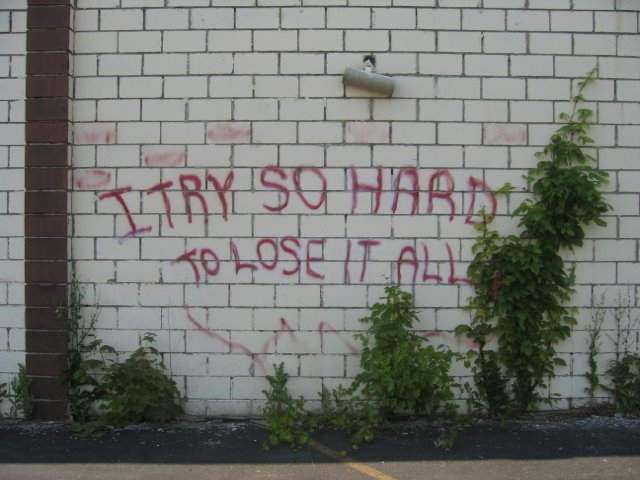
Well, I knew there was some wisdom to be gained from waiting for my next special guest for an hour after driving two hours in the heatwave, then driving back after he no-showed. But I am still not completely convinced it is wisdom. Coming soon, another discorrelated replacement for the very city, which again we missed stepping foot upon. Is it always the power of the falls that sweeps us away? The powers of the false might get us closer. I really am trying. The wisdom of the graffiti found the next day tells us that it is difficult to fail, that one has to try at that too. Sadly, though, mulling over the genius on the wall, I think it is a product of faulty grammar (genius produced by its reverse) . . . to its left and right are other more unschooled evocations of something gone awry, without the hint of the spiritual exuberance of El Ghazali ("you possess what cannot be lost in a shipwreck") or the Buddha, so that, one can only conclude that she means "I try so hard and lose it all." I still think I'm in the world of this "and."

Labels: , , ,

Monday, June 19, 2006

Pat(t)erson: Two T's or One?

Day One
In search of the elusive Paterson--both the poem and the city--we find ourselves not in New Jersey but in Patterson, Georgia, about 40 miles north of the Okefenokee Swamp. Our special guest drifter, Clark Lunberry, has a good sense of the pith and essence, the quiddity and je ne sais qua of Paterson, yet has never been there. This Patterson was conveniently at hand, perhaps too convenient compared to the chaos of Paterson, NJ where the falls--once the unmanageable, excessive, flowing-matter against which the poet would fail to measure--is now a quaint vignette compared to its environs. Clark talked about how Williams at one point started to hate the poem and its failure. I found it hard to believe that Williams didn't start the poem knowing full well his barrel was heading for the Passaic River's misty plummet. We found a dead library, a rocket to Jesus, and a very good cafe with a jangly piano in the next town over, where Clark requested I play "Somewhere Over the Rainbow" (he's from Kansas) and I obliged with an approximation.
Clark's work on Williams and Robert Smithson, "So Much Depends: Printed Matter, Dying Words and the Entropic Poem" can be found at:
http://www.unf.edu/~clunberr/research.html

Labels: , , , , , ,