Sometimes the best insights come while watching television in hotel rooms. I had a minor Raymond Williams moment the other night in Ardmore, PA, watching
Family Guy after coming across the word “paragram” used to describe certain poetic effects (see
Perloff, McCaffery, Kristeva, Roudiez,
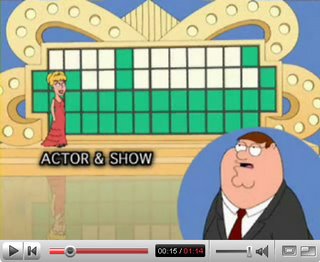
Marsh.) The episode begins with Peter playing
Wheel of Fortune and it’s clear that he is so oblivious to the basic rules and generic conventions of the show that he calls the host “Regis,” rattles off a string of hilariously useless “letters,” and doesn’t understand that the “fat man in the circle” is a keyed-in video image of himself. If you look up paragram, you’ll see that it merely means a “pun.” But, I think it is used in the context of poetic theory to imply more broadly what happens when the meaning of a word oscillates because of the unstable rules by which we are to understand it. We appraise the word through a montage of contexts, rather than a montage of words themselves. Compare, for example, the use of a word in Futurism and one in Language Poetry. The Futurist word is a verbal piece of shrapnel, an object-in-itself, flung; whereas the Language Poetry word radiates in multiple dimensions precisely because we are not sure how to take it. Lytle Shaw talks about this dynamic in the Williams-inspired work of Robert Smithson, whose word pile we saw in the last entry. Shaw says that Smithson engages multiple genres such as “science fiction, geology, travel narrative, philosophy, poetry, art criticism, pulp drug novel, cartography, and film treatment” (
124) to force the extreme dislocation of his non-sites, his various concrete poems (“concrete” in various dimensions; “poem” in various dimensions). So it is that, for Williams'
Paterson, we are immediately given directions how to “take” the book; those directions are just as immediately thwarted. At the beginning of Book I, Williams sets out a kind of subtitle to
Paterson:
“: a local pride; spring, summer, fall and the sea; a confession; a basket; a column; a reply to Greek and Latin with the bare hands; a gathering up; a celebration;
in distinctive terms; by multiplication a reduction to one; daring; a fall; the clouds resolved into a sandy sluice; an enforced pause;
hard to put to it; an identification and a plan for action to supplant a plan for action; a taking up of slack; a dispersal and a metamorphosis.” (2)
Subtitles tend to place and frame the work, but this list of genera is more like Borges’ example of the Chinese encyclopedia. What is Paterson? Some of the answers veer towards the surreal (Paterson is a basket) some defy the basic grammatical premise (Paterson is in distinctive terms). Rather than an exploration of the materiality of the signifier, this type of humor banks on the immateriality of the premises which give sense to the signifier. After all, Paterson can be spring, summer, fall and the sea, the batman symbol and Alex Karras in Webster.
Labels: Book I, comedy, Family Guy, Futurism, Language Poetry, Lytle Shaw, paragram