Tuesday, March 30, 2010

Golden Coach into the Future


Golden Coach Diner, where Smithson had lunch on his famous New Jersey drift (in "A Tour of the Monuments of Passaic, NJ") is now a Dunkin Donuts. Not too bad a fall into the future. I'm at a donut shop now, and this morning I heard someone asking "do you have, you know, those mini-donuts, the holes." At least Dunkin Donuts has a name for these. Although I think Smithson would like the idea of going to a donut shop and asking for a box of holes. "Can I have a thing that is a hole in a thing it is not?" They should be called do-nots, or do-knots.

Labels: ,

Saturday, May 24, 2008

The Mystery of His One Two, One Two

On the track of Williams' play with numbers, which might give us a sense of his theory of sexuality (reducing, difficultly, notions of sex to epiphenomena of mathematics), I've happened upon a "number" of secondary sources that philosophize the one, the two (and multiples beyond) in a similar spirit. I won't go into the passage I originally intended to comb through for this entry, the passage on pp.17-18 of the two girls and their hair and the ribbons of their hair (in the air of the falls), because I thought it would be easier just to excerpt a part of our discussion at the VSW about it here. Nevertheless, here are the chance finds that accompanied me as I started philosophizing the one and the two that underpin Paterson's "elucidation by multiplicity:"

1. Saul Anton's new book, Warhol's Dream, which contains a fictional conversation between Robert Smithson and Andy Warhol about the important difference between a single Empire State Building and the Twin Towers, in a discussion of infinity, time and space. (Williams, of course, was a big influence on Smithson, so the resonances here come as no surprise.)

2. Italo Calvino's t zero, short comedies of cosmogony--the originary split of the one into multiplicity at the beginning of the world. (When he talks about the one and the city, Williams seems like he's attempting modern urban technogony.)

1. Elisabeth Tonnard's The Two of Us: an artist's book made here at the VSW, based off the Selle collection, an abandoned ocean of street vendor photography from Fox Movie Flash, taken in the 40s and 50s. There are literally a million images, saved from the dumpster, with each roll containing 1500 pictures (the process was a hybrid of flash photography and film), and I was able to see the numbered rolls in their drawers, where they share a toxic, moldy storage room with castaway magic lantern slides and other dead media. The past is not for the faint of heart, not only because of the air quality with which any tomb raider must reckon, but also because projects like Tonnard's interface an archival substrate so vast as to verge on the unknowable (even though, technically, it can be "counted": there is a good essay on the aesthetics and philosophy attending the sheer numbers of these photos by Christopher Burnett in Afterimage 35.3 called "The Streets of San Francisco: Encounters with the Selle Collection of Street Vendor Photographs"). Tonnard's The Two of Us is based on a simple organizational premise: collect pictures from the relatively small number of those digitized (18, 000) that hold within their frame the figure of the "double." So this fiction of two--an unsettling two--holds off the infinity of actual, material everyday (which may constitute its "virtuality") that is the difficult substance of which both this project and Williams' Paterson attempt oblique knowledge.

Labels: , , , , , , , , , , ,

Sunday, May 04, 2008

In sterquilinio putredinis

I am convinced that the future is lost somewhere in the dumps of the non-historical past; it is in yesterday's newspapers, in the jejune advertisements of science-fiction movies, in the false mirror of our rejected dreams.
--Robert Smithson
The essential starting requirement is in the shit-heap of our putrefaction.
--Morienus, the Roman
Somewhere between Smithson's kodachromed futurism and the epiphanies of ancient alchemists, one can find one's way through Williams' Paterson. However, in getting together some materials for another talk I'm giving on Paterson, I'm finding that trying to unify all these transhistorical strategies for perceiving the everyday has many rabbit holes to fall through. At one point, I thought it might be interesting to think about the univocity of being (as it manifests itself in German mysticism, Spinoza, Deleuze) as a way to think about the ways in which Williams confounds a clear notion of his own position, and its relation to the city and poetic "transcendence." That didn't really pan out. I think, in the end, things get too "profound," full of secret underlyings-- difficult to pin on someone who said "the surface/glistens, only the surface./Dig in--and you have/a nothing, surrounded by/a surface, an inverted/bell resounding." (124) This is a long cry from "aaa ooo zezophazazzzaïeozaza eee iii zaieozoakoe ooo uuu thoezaozaez eee zzeezaozakozakeude tuxuaalethukh"--a gnostic password that immediately gets one into VIP lounge of angels and archons.
In any case, throughout May I'll be working on the more large-scale portion of this project as a resident at the Visual Studies Workshop. Not sure how much of that will pan out in blog entries, but we'll see. I'm still hoping to get a reading group together in Rochester (not sure if this will happen yet either), and I bet I can find an all-female thrash band who will do the Marcia Nardi letters. One can only hope. Some more Paterson visits?: not sure. I think Richmond, Virginia is closer to Paterson than Rochester is, even though I fooled myself into thinking that Rochester would put me in close contact.
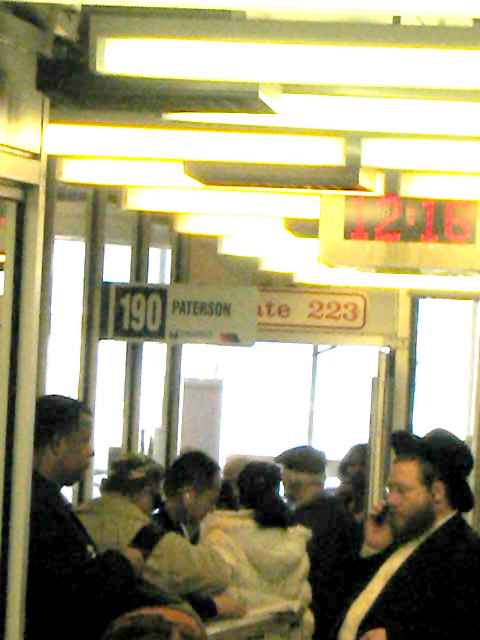
This much, however, I know so far about Rochester: chair 223 is a deathtrap.

Labels: , , , , , , , ,

Friday, July 20, 2007

Anywhere is Everywhere


The Flux Factory project in Paterson, which I participated in for the last month and a half, finally settled on a plan for a monument to Paterson, the city. What you see here is the plan of a walking-path, created by imposing the design of a spiral on the city (nods to Smithson’s Spiral Jetty), and then tracing the streets that the spiral intersects. During the meetings leading up to this particular solution, I would get tired and headachy because it seemed like the initially proposed paths were so inclusive and conceptually vague that I felt it would be better just to go to the gas station, buy a map of Paterson, hand it to the mayor and announce “here is your monument!” This path is still overwhelming, especially because of the territorial nature of neighborhoods in Paterson . . . people don’t usually cross into areas they “don’t belong” . . . not to mention its sheer length. Regardless of whether the path has the powers to somehow wear away these invisible borders, I think it can at the very least be a good template for an urban mapping project a la Yellow Arrow or Google Maps, with anybody able to input data for points along the path. Also, to create a more palpable, virtual sense of a monument that strains even the most dogged psychogeographer’s good will, there will be a mini-version that can be placed on the floor of the museum or other space in Paterson. In much the same way that medieval labyrinths provided a place for pilgrimage when actual trips to the holy land were difficult to realize, this unicursal floor maze will provide a way to think about the territory and the map in dynamic relation.
Click here for Patersonian Don Kommit’s poem commemorating the project.

Labels: , , , , , ,

Monday, June 04, 2007

The Bridges of Passaic County

Saturday was my first overnight in Paterson. After the opening at the museum, we sat in the backyard at the new crash pad and ate Chinese food under tiki torches. "Who is the Andy Warhol of hip-hop?" I asked as the conversation veered towards the artistic merit of one of our dinner guest's bump and booty-style videos. "Missy Elliott," was the unanimous reply.
The next day, after the first meeting of the Paterson reading group, while driving back from dropping someone off in Glen Rock, I saw an old bridge over the Passaic. Was this the bridge Smithson talks about in "A Tour of the Monuments of Passaic, NJ"? Even though the walkway was paved (instead of the wooden slats on the Smithson bridge), it looked like the one. Later, when I checked a map I realized I was way off. In fact, Brian Dillon's article "Objects in the Mirror" tells us that the bridge Smithson photographed no longer exists, replaced by a "flat, bare concrete structure bordered by wire fencing and punctuated by a few unconvincing replicas of nineteenth-century lampposts." (41) What a map does reveal is that there is a necklace of bridges over the Passaic that surround the Paterson area, which may be in various states of repair/disrepair. Of them, this is ostensibly number 9. I'll have to take a drive along the Passaic soon to check out the others.
Now, if I can only find hip-hop's Robert Smithson. . . .

Labels: , , , , , ,

Saturday, May 12, 2007

No Socially Shared Metaphysic

Flux Factory has just released its schedule of free tours, parties, meetings, and readings to take place during its happening in Paterson this June. Among other things, I will be hosting Paterson reading group, with meetings and tours throughout June (download the schedule for dates and info.)
The purpose of Flux Factory is to use this month--in cooperation with inhabitants of Paterson--to conceive of a monument for the city. In conceptualizing some kind of urban monument, my two blogs collide. On "The Woonasquatucket Primitive," I already expressed my cynicism at the unchecked proliferation of monuments of all stripe in the Providence riverwalk area, in deference to the more modest interventions of an anonymous artist I recently discovered to be a homeless man. Will this Paterson monument be a "real" monument? Such a thing could provide some sort of sense of public meaning, even though, as Richard Serra pointed out in reference to his anti-monuments "there is no socially shared metaphysic." The last time I was in Paterson, we discovered a depressingly perfunctory tombstone behind chainlink fence commemorating the underground railroad: at the very least, something like this should be given the dignity that is misdirected onto the Lou Costello statue. But a monument is surely a luxury, and perhaps would even be construed as a sign of corruption or frivolity in a city like Paterson, which would be better off investing in the future than the past. It has been suggested that Flux buy a cheap house for urban youth programs. Or, in the end, given that they call themselves "flux," the happening itself could be a kind of dematerialized monument, based on the heightened interactions of people who would not normally have met. The impulse to memorialize in Paterson will undoubtedly meet with a score of paradoxes and ironies. In fact, this preference for future growth over historical past is perhaps based on a false distinction. As Robert Smithson pointed out, New Jersey is precisely the place where the future fails, and its landscape memorializes the ruin of impossible utopian projects.

Labels: , , , , ,

Friday, February 23, 2007

Buried Heterogeneity: Lytle Shaw on Paterson

Writer Lytle Shaw talks about Williams, Smithson, site specific art, poetry of place, geological samples, crystals and the "stupid ass things" Williams is capable of. I had planned to save this material for mixing into another Paterson radiophonic study, but it's worthwhile posting it fully here. I conducted this interview 10-20-06 in New York City. Stay tuned to hear it make its way into a more multifarious material stratum.
Lytle Shaw talks about the relation of Paterson to his work: (7 min.)
On the songlike passages in Paterson: (1 min. 30 sec.)
Is Paterson like a fractal?:(1 min. 50 sec.)
Paterson the city, poetics of place and site-specificity: (6 min. 40 sec.)

Labels: , , , ,

Saturday, December 02, 2006

There is No Direction. Whither?

I spent Thursday exploring Paterson. This time, I set off in the way Robert Smithson suggested in his "Tour of the Monuments of Passaic, New Jersey" (1967): starting from gate 223 atop New York's Port Authority bus terminal, accoutred with a cheap still camera. Accessible thru labyrinthine warrens of glass and escalator, the bus makes the journey every 20 minutes, at all hours. It was a much more leisurely option than driving in, except for the shrillness of the bus's brakes at every stop, which I guess you might be able to listen for before you get on, and wait for the next if it is too deafening. By taking the bus, I would be able to see an ingress to the city that I had not mapped myself, and be forced to walk once there. The bus goes through the Secaucus swamp lands, then through Williams' Rutherford ("Borough of Trees"), through Clifton, past the Middle Eastern enclave in South Paterson, and finally to the downtown area (the bus stop at Broadway has a snack shop where the drivers hang out and everybody seemed happy). After having my picture taken in front of the falls for tomorrow's Paterson Herald, and recording some material for future vlog entries, I had a bowl of fish soup in one of the many Peruvian restaurants on Market, and then took a long walk south down Main Street. I tried to find a way to climb up Garret Mountain, since it looked inviting, but since it is almost winter (even though it was about 70 degrees), the day was over before it could begin. Instead I walked until I found a Turkish pastry shop, had an arabic coffee, and hopped on the local bus back to New York.

Labels: , , ,

Monday, June 19, 2006

Pat(t)erson: Two T's or One?

Day One
In search of the elusive Paterson--both the poem and the city--we find ourselves not in New Jersey but in Patterson, Georgia, about 40 miles north of the Okefenokee Swamp. Our special guest drifter, Clark Lunberry, has a good sense of the pith and essence, the quiddity and je ne sais qua of Paterson, yet has never been there. This Patterson was conveniently at hand, perhaps too convenient compared to the chaos of Paterson, NJ where the falls--once the unmanageable, excessive, flowing-matter against which the poet would fail to measure--is now a quaint vignette compared to its environs. Clark talked about how Williams at one point started to hate the poem and its failure. I found it hard to believe that Williams didn't start the poem knowing full well his barrel was heading for the Passaic River's misty plummet. We found a dead library, a rocket to Jesus, and a very good cafe with a jangly piano in the next town over, where Clark requested I play "Somewhere Over the Rainbow" (he's from Kansas) and I obliged with an approximation.
Clark's work on Williams and Robert Smithson, "So Much Depends: Printed Matter, Dying Words and the Entropic Poem" can be found at:
http://www.unf.edu/~clunberr/research.html

Labels: , , , , , ,