Friday, December 04, 2009

Paterson Pageant!

I've been meaning to do something about this historical curiosity from Paterson for a long while, but then was tempted to just post it as an unsung piece of data (a la Williams), because what else can you do but reflect on the oddness of the event, and the abyss of history that separates us from the idea of a radical political "pageant" that the proletariat would take seriously as a means of action. Indeed, while we usually think of 1968 as one of those rare moments where art was taken seriously as part of political change, here we had a much earlier moment when the New York avant-garde and the strikers of Paterson came together to mount an entirely new form of political "representation." In fact, this experiment in the summer of 1913 would turn the distinction between representation/propaganda and presentation on its head by having the very strikers as actors. As the New York Tribune wrote at the time:
"There was a startling touch of ultra modernity—or rather of futurism—in the Paterson strike pageant in Madison Square Garden. Certainly nothing like it had been known before in the history of labor agitation. The I.W.W. has not been highly regarded hereabouts as an organization endowed with brains or imagination. Yet the very effective appeal to public interest made by the spectacle at the Garden stamps the I.W.W. leaders as agitators of large resources and original talent. Lesser geniuses might have hired a hall and exhibited moving pictures of the Paterson strike. Saturday night’s pageant transported the strike itself bodily to New York. . . ."

Indeed, the spectacle of 1200 workers walking from Paterson to Madison Square Garden to perform challenges the very notion of "spectacle;" we perhaps instead enter the realm of the simulacrum (without the cold video eye, or the potentiality for the anesthetizing rewind).
The one reference to this event happens in Book III of Paterson, an excerpt from a letter to Williams from a friend who had participated in the event: "Rose and I didn't know each other when we both went to the Paterson strike around the first war and worked in the Pagent. She went regularly to feed Jack Reed in jail and I listened to Big Bill Haywood, Gurley Flynn and the rest of the big hearts and helping hands in Union Hall. And look at the damned thing now."
While the last sentence seems to comment upon the loss of energy and "pagentry" [sic] of the I.W.W. or American labor politics in general, there is a comment in the MacGowan footnotes that makes me think that this statement is Williams ventriloquizing. And yes, he is perhaps reflecting ruefully on the failure of labor politics, but maybe also making a meta-comment about his own labor of "page-entry." "And look at the damned thing now" seems to have been a comment this friend made--not ruefully but enthusiastically--when he finally saw how Williams had progressed with Book III.
Some of the many documents on the web about the Paterson Pageant include archival documents collected in an issue of TDR (summer 1971, pp.61-71), a book on the impact of this show on emergent modernism, and a lot more to explore.

Labels: , , , , , ,

Wednesday, November 11, 2009

Old Home Day, and the Old, Old Home

Just out, Zack Pieper, Erica Kaufman, and I celebrate old home day in the Kelly Writers House over Notley's I, The People. Whether the home was Milwaukee (where we all have lived), Pennsylvania (I can go toe-to-toe with Al Filreis on Action News trivia), 10 & A, or another virtual or metaphorical "home" is uncertain.
I've been thinking about one of my comments that, left on the cutting room floor, perhaps deserves some mention here and then elaboration. In our discussion of the actuality of 10 & A (the recurring theme of the reality or absurdity of using poems as maps has been a theme throughout this blog), I had mentioned the importance of 10 & A--allegorically and actually--as at the edge of Alphabet City. There is a sense of the primal quality of being on the edge of speakability/calculability, with the number 10 and the letter A signifying, respectively, the base 10 number system and the alphabet itself. We can also think of the history of gentrification, and this particular locus as a borderline, which indeed is impacted by the presence and presencing of poets. But this poem also engages with the mystical consciousness that goes beyond the place where number intersects with letter, the democratic systems that writers such as Poe railed against in their preference for visionary consciousness over systemic politicized rationality.
I'm rereading today a translation by Charles Doria of the "Secret Book of Moses on the Great Name, A Book About Everything, In Which Is Contained The Name of the One Who Ordains Everything That Is," a book that twists the name of God into all possible combinations until it is exhausted and the performer hence becomes God (in a lovely Arthur C. Clarke short story about a computer in a Himalayan monastery that sets out to do this, the results are less, let's say "hubristic.") In his intro to the "Secret Book," (printed in Kostelanetz's Text-Sound Texts anthology) one is "reminded"--perhaps from some great archaic echo--that this Tetragrammatic remix, written in Greek, is not based off of the Hebrew YHWH, but rather the Greek iota, alpha, omega, which transliterates as I-A-O. Is it a stretch to posit 10 & A, as I-A-O, with Notley riffing on the names of God? These lines from the old poem seem apt: "I want You alive/all the time of this My life here/make for Me all My soul desires/for You are Me and I am You/something if I say it has to be/for I possess Your Name/in the phylactery of My heart/and all flesh moved against Me/shall not hold Me back . . ./for I am Named You Your Name is in My Soul."
As if to seal the deal, the Horus eye, which I noted appears on the facade of the cafe at the northeast corner of 10 & A, appears as an image (mere doodle or mystic oogle?) in the original papyrus of this Egyptian text (home continues to evade us). Some intersection!

Labels: , , , , , , , , , , , ,

Tuesday, March 17, 2009

Paterson Datum no. 36

Thursday, June 19, 2008

Et in Paterson Ego

Perhaps it is appropriate to talk about displacement after driving over 4000 miles and never once passing through our locus of inquiry. Along the way, I talked to some fellow-travelers of the Paterson poem in Philadelphia--tk in a future entry--and sat through a rousing 4.5 hours of Feldman's For Philip Guston in Charleston--which gave me some ideas for the progressing audio piece, or at least some insight into the true nature of stamina (the pianist endured a surreal wardrobe malfunction for close to 20 minutes, and I really don't know how they venture into such an undertaking without Depends.) I fear along the way, as Charlestons became Missoulas, that I might have forgotten some of the insights gained along the way, lost to an amnesia of miles. But that may be for the best, a letting-go which both astronauts and Morton Feldmans know something of. What would constitute a pastoral for our age of astronauts? Because it is Williams' use of the pastoral which I held-to as the next entry, since one of my conversants in Philadelphia, Randall Couch, brought up the genre in relation to the pastoral parody in Book 4, and sent on this link to a precursor. The pastoral is a genre of displacement: a way for mostly city folk to imagine their more authentic shepherd counterparts, like Rush Limbaugh conjuring Dakota. Williams places the pastoral conversation that begins Book 4 in New York City--it took me a couple reads to get this, given that one at least imagines the points-of-view, however fractured, to be limited by the poem's titular city. It could be that this pied-à-terre on the East River, inhabited by a lesbian poet (and this I totally missed, but thanks to Randall for pointing it out) is, in a pointed reversal, the Arcadian hinterland where one can escape the actual reality of the city or cities or "things" in their terrible intensity. No ideas but in things: et in NYC ego. "The whirring pterodactyl/ of a contrivance, to remind one of Da Vinci,/searches the Hellgate current for some corpse" and this helicopter is the snake in the grass, the shadow of death that haunts this "idyllic" escape. While Randall pointed out book four's relation to an 18th-century tradition, I think Williams maintains a discussion with poets much further back, especially Theocritus and Vergil. One thing that brought me back to Vergil was a passage that I kept recalling when thinking of Williams' use of numbers and the passage on page 18 of the two girls and their ribboned hair. This is from Eclogue 8, depicting the song-competition of Damon and Alphesiboeus "at whose rivalry the heifer marvelled and forgot to graze":
ALPHESIBOEUS
[64] “Bring out water, and wind soft wool round this altar; and burn rich herbs and male frankincense, that I may try with magic rites to turn to fire my lover’s coldness of mood. Naught is lacking here save songs.

Bring Daphnis home from town, bring him, my songs!

[69] Songs can even draw the moon down from heaven; by songs Circe transformed the comrades of Ulysses; with song the cold snake in the meadows is burst asunder.

Bring Daphnis home from town, bring him, my songs!

[73] Three threads here I first tie round you, marked with three different hues, and three times round this altar I draw your image. In an uneven number heaven delights. Weave, Amaryllis, three hues in three knots; weave them, Amaryllis, I beg, and say, ‘Chains of love I weave!’

Bring Daphnis home from town, bring him, my songs!

[80] As this clay hardens and as this wax melts in one and the same flame, so may Daphnis melt with love for me! Sprinkle meal, and kindle the crackling bays with pitch. Me cruel Daphnis burns; for Daphnis burn I this laurel.
Here is an early version of "no ideas but in things." While Damon frets over lost love and threatens to jump in the ocean, Alphesiboeus succeeds by busying himself with earth-magic and binding rituals. There also may be something to the relation between "in uneven number heaven delights" and Williams triadic line. Nevertheless, I think a look back into ancient pastoral points to a timeless struggle between vague lyricism and a materialist poetics, perhaps mistakenly limited to the innovations of the 20th century.

Labels: , , , , , , , ,

Saturday, December 02, 2006

There is No Direction. Whither?

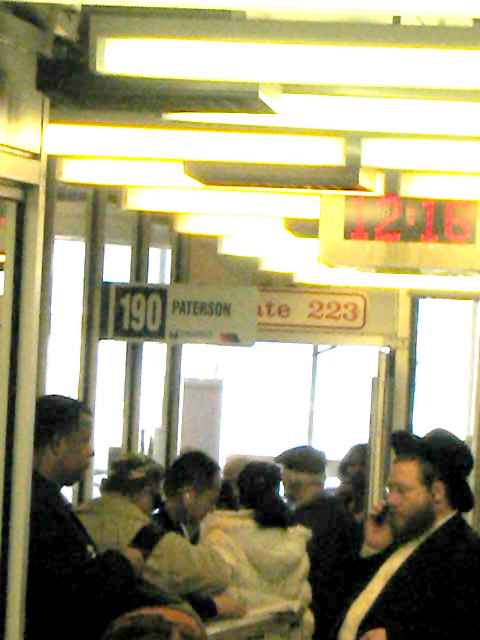
I spent Thursday exploring Paterson. This time, I set off in the way Robert Smithson suggested in his "Tour of the Monuments of Passaic, New Jersey" (1967): starting from gate 223 atop New York's Port Authority bus terminal, accoutred with a cheap still camera. Accessible thru labyrinthine warrens of glass and escalator, the bus makes the journey every 20 minutes, at all hours. It was a much more leisurely option than driving in, except for the shrillness of the bus's brakes at every stop, which I guess you might be able to listen for before you get on, and wait for the next if it is too deafening. By taking the bus, I would be able to see an ingress to the city that I had not mapped myself, and be forced to walk once there. The bus goes through the Secaucus swamp lands, then through Williams' Rutherford ("Borough of Trees"), through Clifton, past the Middle Eastern enclave in South Paterson, and finally to the downtown area (the bus stop at Broadway has a snack shop where the drivers hang out and everybody seemed happy). After having my picture taken in front of the falls for tomorrow's Paterson Herald, and recording some material for future vlog entries, I had a bowl of fish soup in one of the many Peruvian restaurants on Market, and then took a long walk south down Main Street. I tried to find a way to climb up Garret Mountain, since it looked inviting, but since it is almost winter (even though it was about 70 degrees), the day was over before it could begin. Instead I walked until I found a Turkish pastry shop, had an arabic coffee, and hopped on the local bus back to New York.

Labels: , , ,

Wednesday, July 26, 2006

A Dissonance in the Valence of Uranium


Day Four
Desparate to get some Paterson footage, even if it is ersatz Paterson, I convince Max Goldfarb to be the next special guest, even though our main objective was to explore a Wal*Mart parking lot in Hudson, NY for wormholes into another dimension. We ride out to the site in a red step van, M-49, a mobile unit once used by the fire department in Stockbridge, now a mobile vehicle for radio experimentation, but maybe also literally still a "fire" truck, since the heat from the metal floor is melting my flip-flops and it only gets worse outside where the air is dead from heat. Fire, tar, dead grasses, Queen Anne's lace, rotted palettes, birds, and (somewhere, like the angels) money: where is Paterson in it all? Again, we are nowhere near Paterson, but closer to an idea of ruins that might be more mid-industrial, Pennsylvanian, quaint. The Patersons proliferate: loose copies of the Platonic mess; yes it is a paradox, since the inner city and this particular poem are in general considered the opposite of the luminous form. But there is an ideal even in a mess. Radio mics give out, hypotheses fail. The real Paterson shames our senses.
Max will be broadcasting an evening of live talks and performances from his van on August 4 in Hudson, NY. (Among others, I'll be giving a talk/tour called "The Theogony of the Parking Lot"). Email
argot@mit.edu for more information.

Labels: , , , , ,